The four-round engine
The cutaway 4-stroke engine is the longest perception-loop story in the jscad-mcp-example repo. It shipped to main four times with bugs that the previous round of inspection couldn’t see, because each bug was hidden behind the one in front of it. Each round was tagged in git (fix(engine): …) so the arc is visible in git log.
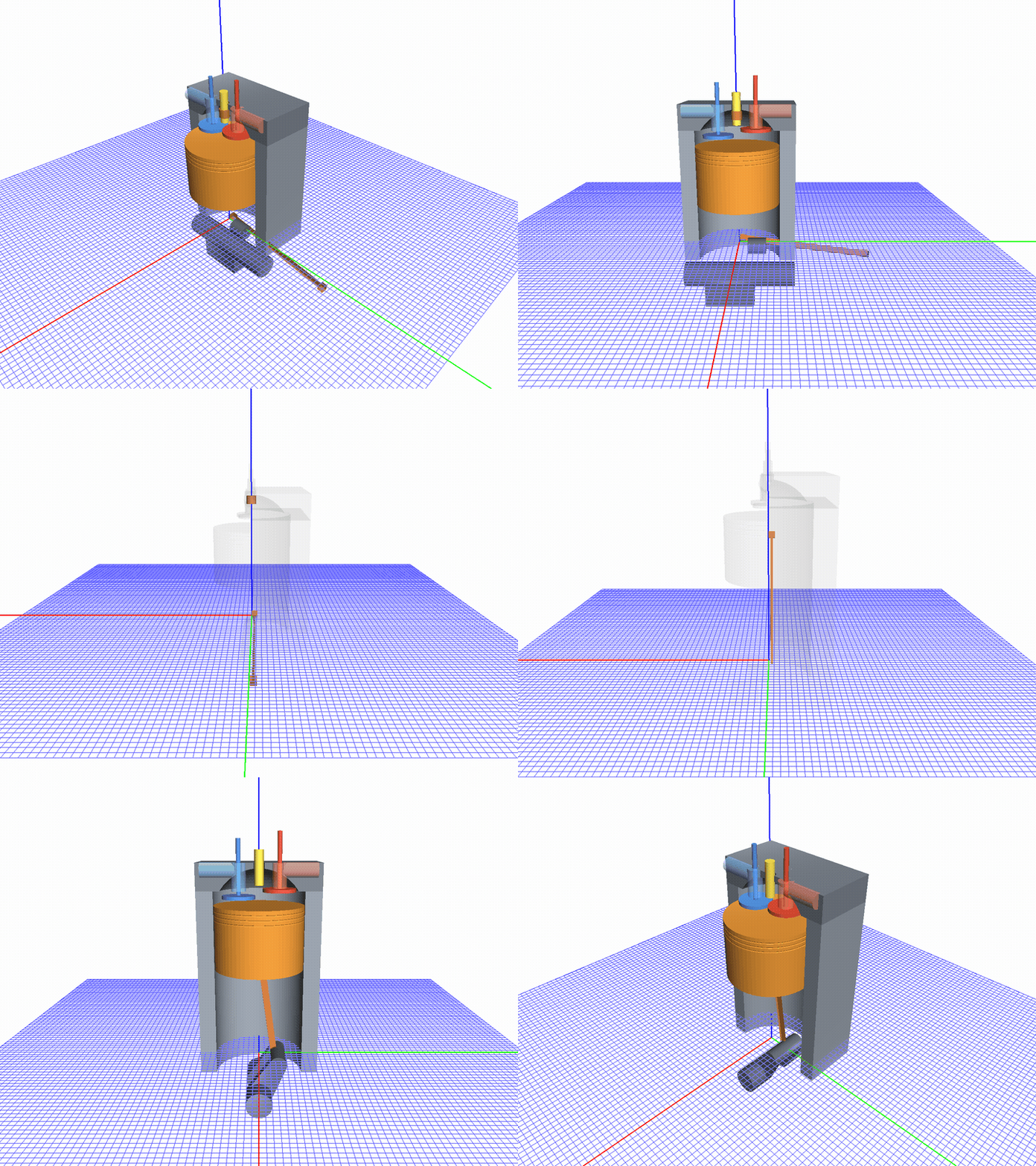
The iteration GIF above is the canonical version of the story — buggy iso looks fine → side view exposes the floating conrod → highlight conrod makes the disconnect unambiguous → fix → multi-angle confirmation. But the actual repo history had four such cycles.
Round 1 — the floating conrod (commit 3421ab4)
Section titled “Round 1 — the floating conrod (commit 3421ab4)”The first build shipped with the connecting-rod I-beam lying flat on the floor along +Y at z = 0, completely disconnected from the engine. The big-end and small-end cylinders sat at their proper positions but the shaft between them was anchored at world origin.
Two compounding bugs: atan2(dy, dz) instead of atan2(dz, dy) (so the rotation pointed the shaft nearly horizontal instead of nearly vertical) plus a missing translate (so the rotated shaft started at world origin instead of the big-end). Invisible in iso and slice_y; obvious in front and highlight conrod.
Lesson: more than two angles.
Round 2 — crankshaft journal axis (commit 3566985)
Section titled “Round 2 — crankshaft journal axis (commit 3566985)”Once the conrod was vertical and visibly connected, a second mismatch became visible: the conrod’s kinematic model put the crank pin orbiting in the Y-Z plane, but crankshaft.js had the main journal running along the Y axis. The journal axis must be perpendicular to the pin’s orbit plane, so it should have been along X. The mismatch made the crankshaft look like a long horizontal bar protruding from the side of the engine instead of a stub-end emerging through the cutaway. Fixed by rotating the journal+pin cylinders 90° (around Y instead of X) and shrinking the oversized counterweight.
Lesson: when one part is moving, all the parts that touch it can be wrong in ways the rendering can’t display until the first part stops moving.
Round 3 — piston/conrod/web alignment (commit 440b59d)
Section titled “Round 3 — piston/conrod/web alignment (commit 440b59d)”With the crank journal pointing the right way, three more bugs surfaced at once:
- The piston’s crown was computed below the wrist instead of above (the formula
crownZ = tdcCrownZ − ((r+L) − yp)meant TDC_CROWN − L ≈ −28 mm — wrist sat 28 mm above crown). The conrod’s small-end visibly stuck up out of the piston’s top face. - The conrod’s bearing cylinders (big-end at the crank pin, small-end at the wrist pin) defaulted to the Z axis, but the pins they were supposed to wrap ran along X. The bearings crossed the pins at a single line instead of being concentric, reading as disconnected.
- The crankshaft had no webs — the crank pin floated next to the journal with no visible physical connection.
Fix: crownZ = wristZ + COMPRESSION_HEIGHT, both bearings rotated to lie along X, and stadium-shaped webs (hull of journal-disk + pin-disk) added on either side of the pin. The block also had to grow — blockHeight = p.conrodLength + 40 instead of p.stroke + 60 — so the bore extended past wrist_TDC = L.
Lesson: a real-world reference (the user’s Crankshaft.STL showing real crank webs) catches geometry mistakes that “looks plausible” can’t.
Round 4 — the journal needs a gap at the throw (commit 8a55581)
Section titled “Round 4 — the journal needs a gap at the throw (commit 8a55581)”Even with proper webs, the crank still had a single continuous main journal cylinder running through where the webs sit. Geometrically the journal passed through the offset webs — something no real crankshaft can do (the webs couldn’t rotate around the journal). A real crank has a gap in the main journal at every throw, with the journal-web-pin-web-journal chain bridging it. Fixed by splitting mainJournal into leftJournal + rightJournal, each JOURNAL_STUB long, with the throw assembly filling the gap between them.
Lesson: “looks right from every angle” is a necessary but not sufficient condition. Could this part physically rotate? — rendered against a real reference — catches what static views miss.
The principle
Section titled “The principle”The same principle, four times: a render is one hypothesis. Each fix unblocks the next one.
- Multi-angle inspection catches round 1.
- Re-inspection-after-every-fix catches round 2.
- A real-world reference catches round 3.
- Asking would this assembly work in the real world? catches round 4.
The full sequence is the perception loop at its most honest: each iteration teaches you what you were unable to see in the previous one.